eFX Apex
The Institutional-Grade Data Hub
- Plus: Discretionary Trades
- Edge: Sentiment Trades
- Alpha: Systematic Trades
- Apex: Full Big Data Stream





• USD net G10 spec long in Sept 30-Oct 6 IMM period; $IDX +0.41%
• USD remained bid into new IMM period on European fiscal & Mideast (oil)concerns
• EUR$ -0.76%, specs -36.1k contracts now -99.3k; French fiscal concerns weigh on EUR
• $JPY +0.54%, specs +6.9k contracts now +62.3k; higher US yields add to USD haven status
• GBP$ +0.35%. specs -6.5k contracts now -97.6k; BoE a high yielder tempers GBP weakness
• $CAD +0.13%, specs -11.5k contracts now -90.2k; US-CA trade tumult, higher Fed policy view
• AUD$ -0.05%, specs -35.3k contracts now -98.6k; RBA highest yielding g7 economy no aid for bulls
IMM Position Table:

Majors w/IMM Performance Chart:

(Paul.Spirgel is a Reuters market analyst. The views expressed are his own)
• GBP$ steady at 1.3230 in NorAm afternoon trade; NorAm range 1.3235-1.3206
• Support remains firm near 1.32 withstanding several tests recently
• European fiscal ructions, geopolitical uncertainties continue to contribute to volatility
• Test of UK fiscal chops for UK leadership coming at October 28 UK Autumn Budget
• UK August GDP, o/p data on Oct 15 next wk, UK employment and CPI OCT 20-21 in focus
• GBP$ supt 1.3206 Friday low, 1.3140 2026 low on June 24, 1.3108 falling lwr 30-d Bolli
• Res 1.3246 daily conversion line, 1.3300 psychological
lvl, 1.3370 38.2% Fib of 1.3675-1.3181
GBP Chart:

(Paul.Spirgel is a Reuters market analyst. The views expressed are his own)
• NY opened near 1.1210 after 1.1243 traded overnight, drop then extended
• USD, US yield & oil gains weighed down EUR/USD
• The pair fell despite rallies in gold, silver and stocks; 1.1188 traded
• EUR/USD held near that low despite a softening in US dollar & yields
• The pair was down -0.16% in the afternoon and was also lower for the week
• Techs are bearish; RSIs, widening Bolli bands indicate downward momentum
• Daily inverted hammer, hold below the 10-DMA reinforce
bearish signals
eurusd

(Christopher Romano is a Reuters market analyst. The views expressed are his own)
Goldman Sachs on EUR/USD and USD/JPY outlook.
"The USD rally has been built on three legs – rate differentials, relative equity/tech outperformance, and Brent back above $100 – but only energy and AI look structural; Fed pricing is the shaky one, and we're the most dovish in G10 (vs mkt pricing) there alongside the BoE. All three drivers have been mean-reverting this year so we think EUR may have run a little ahead of fundamentals in the near term and USDJPY for example, has structural downside asymmetry, so it's a bit early to press USD strength here...," GS notes.
"Overall, yes, you have some of those fundamental supports, but it is a fairly mean reverting environment and it's also very difficult to rule out some of the USD negative risks that we saw throughout the year on the fiscal front, on the policy uncertainty front," GS adds.
• NY opened near 0.6975, pair fell early on firm USD & yield
gains
• 0.6965 was neared but buyers emerged as USD & yields then softened
• Rallies in gold, silver, copper & stocks and USD/CNH's drop helped lift AUD/USD
• The pair sat near 0.6980 late, it traded up +0.25% in NY's afternoon
• AUD/USD is consolidating its recent drop which gives bears some comfort
• Rising daily, monthly RSIs indicate upward momentum
however
audusd

(Christopher Romano is a Reuters market analyst. The views expressed are his own)
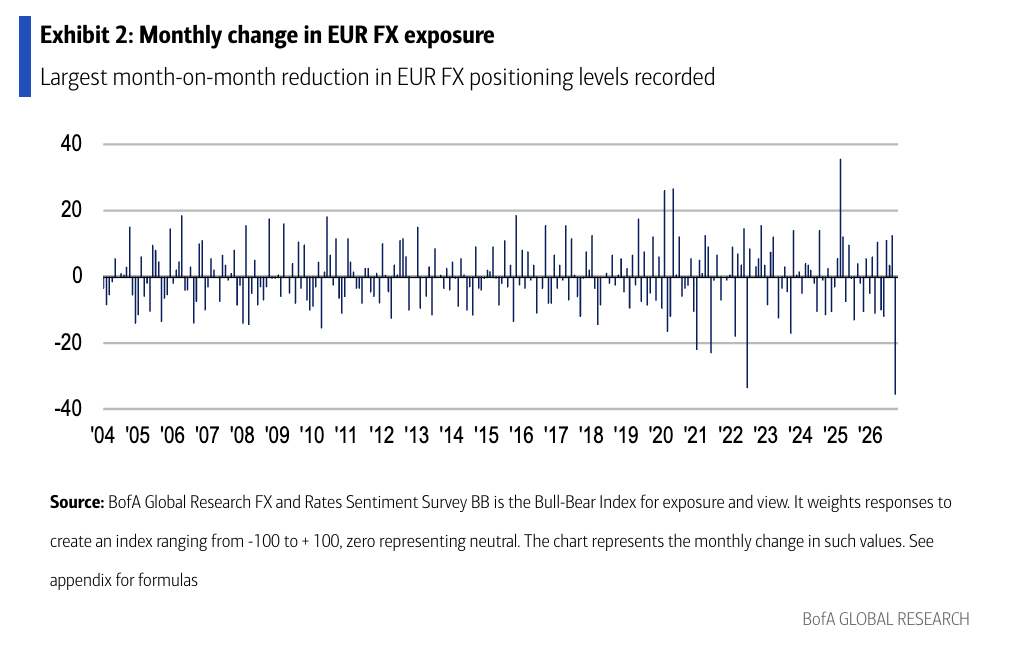
Bank of America Global Research highlights the latest findings from its FX and Rates Sentiment Survey.
"Markets have been rattled by the global government bond selloff, but global benchmark investors are not yet panicking. 70% of respondents believe it reflects improved growth, up from 30% last month. Global duration exposure rose slightly even as yields climbed, and long rates remains the highest conviction trade," BofA notes.
"There are pockets of large position changes: EUR FX exposure was cut by the most on record, peripheral bond exposure fell to the lowest level since Jan 2024 and EM FX exposure retreated from 15-year highs. Yet this bearishness is not at contrarian stretched levels from a historical perspective," BofA adds.
By Justin McQueen
LONDON, Oct 9 - The New Zealand general election due November 7 is a key event risk for NZD, as polls point to a tight race. Labour has lost ground from its earlier poll lead and is now broadly neck-and-neck with the National party.
For NZD, the key issue is the RBNZ mandate. Labour has signalled it would bring back the dual mandate, reintroducing maximum sustainable employment objective, alongside price stability after the current government removed the employment objective in 2023.
With the unemployment rate at an 11-year high, a Labour victory would likely be initially viewed as dovish. Markets would naturally price a greater probability that the RBNZ would place more weight on labour market conditions, thus prompting an unwind in tightening expectations and therefore weighing on NZD.
Given this election-related policy uncertainty, AUD/NZD
stands well-placed to continue performing in the lead up to the
election, with the door open for a move towards fresh highs
above 1.2500. A clear Labour win would reinforce that view,
sparking an extension to the uptrend.
NZ unemployment rate

AUDNZD during elections
(Justin McQueen is a Reuters market analyst. (The views expressed are his own).)
((Email: ))
CIBC Research reviews today's Canada jobs report for the month of September.
"Canadian employment slumped again in September, with the unemployment rate ticking up slightly as new US tariffs took hold. The 68K decline in employment was in stark contrast to consensus expectations for a modest 10K rebound, and followed a 42K drop in the prior month as well. Data volatility appears to have been the main cause of the decline, with a 35K reduction seen in education services which often exhibits volatility around the start of new school years. However, the 13K decline in manufacturing employment could be a sign that new US tariffs are taking a toll. Through the monthly volatility, the 6-month average employment growth now sits at just 9K. The unemployment rate ticked up to 6.5%, which was in line with the consensus forecast and was prevented from rising further by a reduction in the participation rate. Wage growth for permanent employees remained only modest at 2.3%, despite accelerating slightly from 2.0% in the prior month.
"Overall, while the weakness in today's employment data is likely more a reflection of data volatility than the impact of new US tariffs, it does support our call that the Bank of Canada will remain patient and keep interest rates on hold at the two remaining meetings this year," CIBC adds.
ANZ Research likes selling USD/JPY on rallies.
"Our bias remains for a stronger JPY over the medium term. Japan combines one of the strongest growth trajectories of the major economies with attractive valuation support and persistent domestic inflation pressures, a backdrop that should allow the BoJ to continue normalising policy while other major central banks are moving in the opposite direction.
"While domestic political developments may create periods of volatility, we view rallies in USD/JPY as opportunities to position for medium-term downside, particularly if the pair fails to sustain a break above the 159 area," ANZ adds.
(Typo corrected)
• Gold modestly firmer as $4200 is tested, but still largely confined to recent range
• Latest lift aided by Trump's statement that the US will not strike Iran before Midterms
• Trendline resistance caps for now, which underscores the view that risks still lean lower
• Further hurdles sit at $4260 (100-day MA) and $4310 (55-day MA)
• Technically, a close above the 55-day MA would negate the current bearish setup
• Though, unless the USD and UST yields sustain a pullback,
gold rebounds should remain limited
gold tech

Justin McQueen is a Reuters market analyst. (The views expressed are his own) ((Email: ))
• EUR/GBP has traded a 10 pip range since the European open; 0.8473-0.8483
• 0.8483 is also the high since Wednesday's 16-month low of 0.8449
• Thursday high was 0.8481. 0.85 (ex-support point) is now a resistance level
• UK PM Burnham's Labour fends off Greens in Holborn by-election
• Snap UK general election? It might suit Burnham, but not pound
• French student protesters vow to keep up their fight after
scoring first win
EURGBP

(Robert Howard is a Reuters market analyst. The views expressed are his own)
• Yen is headed for a fourth weekly drop in a row
• Overall bias remains on the upside as USD/JPY usually climbs in October
• USD/JPY has seen a 157.77-158.42 range, on Friday, according to EBS data
• The 14-day momentum reading is positive, highlighting the bullish bias, 160 a target
• However the daily cloud, that currently spans the 157.94-159.60 region, weighs near-term
• USD/JPY and EUR/JPY tend to move in tandem, log
correlations are high above +0.5
Daily Chart

Correlation Chart

(Martin Miller is a Reuters market analyst. The views expressed are his own)
• AUD/USD rises to eye 0.6990 as US dollar eases on Trump guidance
• Trump says US will not attack Iran before midterm elections on Nov 3
• 0.6990 is October high-to-date (on Tuesday). 0.6995 was Sept 30 high
• CFTC data at 1930 GMT will show if net AUD short rose again in week to Oct 6
• Net AUD short hit nine-month high of 63,239 contracts in week to Sept 29
• RBA meeting minutes, Australian employment data due next
week
AUDUSD

(Robert Howard is a Reuters market analyst. The views expressed are his own)
• Huge FX option strikes at 1.1200 (€1.8bln) and 1.1250-55 (€3.5bln) expire at 10-am New York cut Friday
• Soon-to-expire FX option attract the largest hedging flows and can add to support/resistance at the strikes
• EUR/USD currently trading well inside these option strike parameters so far on Friday - 1.1212-43 (EBS)
• Key tech support is Monday's 16-month low 1.1161, resistance at Tues recovery high 1.1276 and Fri's 1.1285 high
• 1.1290 is 23.6% Fibo retrace of 1.1711-1.1161 drop. Sellers touted 1.1310-30 - where French debt breakdown began Oct 1
• Option prices ease as spot consolidates into long US holiday weekend, but keep danger
premium on the downside
EUR/USD daily chart (EBS)

(Richard Pace is a Reuters market analyst. The views expressed are his own)
• Cable rises to 1.3250 as oil prices fall on Trump's Iran war guidance
• Trump says US will not attack Iran before midterm elections on Nov 3
• 1.3185 was one-week low on Thursday, as oil prices rose
• US is a net energy exporter; Britain is a net energy importer
• Pimco's CIO says 10-year UST yield could rise to 6% for first time since 2000
• UK PM Burnham's Labour fends off Greens in Holborn
by-election
GBPUSD

(Robert Howard is a Reuters market analyst. The views expressed are his own)
• FX option strikes expire at 10am New York/14:00 GMT on Friday October 9
• EUR/USD: 1.1200 (1.8BLN), 1.1225 (403M), 1.1235-40 (783M), 1.1250-55 (3.5BLN)
• 1.1280-90 (745M), 1.1300-05 (936M)
• USD/CHF: 0.8250 (380M), 0.8300 (520M). EUR/CHF: 0.9320-25 (445M)
• GBP/USD: 1.3200 (486M), 1.3220 (184M), 1.3300 (759M). 1.3400 (630M). EUR/GBP: 0.8500-05 (200M)
• AUD/USD: 0.6900 (1.4BLN), 0.6950 (904M), 0.7000 (1.1BLN), 0.7025 (508M), 0.7045-50 (1.4BLN)
• NZD/USD: 0.5550 (190M), 0.5750 (733M). AUD/NZD: 1.2325 (213M), 1.2470 (600M)
• USD/CAD: 1.4195-1.4200 (367M), 1.4220 (240M). EUR/JPY: 180.50 (492M)
• USD/JPY: 157.00 (1.3BLN), 157.20 (780M), 157.45-50 (1.1BLN), 158.00 (1.6BLN), 159.00 (721M)
• FX options wrap - Lurking dangers underpin hedging costs (Richard Pace is a Reuters market analyst. The views expressed are his own)
• GBP/USD up 0.1% in Asia after yet another recovery from below 1.3200
• Solid base forms @ 1.3180-90; more support @ 1.3140-1.3160 lows in Mar, June
• US yields close lower after a strong 30-year bond auction, supporting GBP
• Pause in European bond selloff also supports GBP sentiment
• Trump's pledge to avoid Iran strike before Nov midterm vote lifts Sterling
• Traders look ahead to next week's busy data and central bank calendar
• US inflation, UK August GDP, industrial and manufacturing output, trade due
• Fed Chair Warsh fireside chat next Fri at IMF/World bank meeting eyed
• BoE officials Sarah Breeden, Megan Greene, Huw Pill, Gov Andrew Bailey speak
• Burnham's Labour hopes to retain former PM Starmer's London seat in Thu vote
• Resistance 1.3250-55, 1.3275-85; Wed range 1.3194-1.3274, Asia
1.3206-1.3221
UK Trade:
(Krishna Kumar is a Reuters market analyst. The views expressed are his own.)
• EUR/USD +0.1% in Asia Fri selling pressure eases on pause in bond anxiety
• EUR entrenched in downtrend, down cumulative 4.2% from 1.1711 Aug 21 high
• Pair targets 1.1065 17-month low, break opens door for move toward 1.0733
• Investors remain wary of FR debt problems despite spending cut promises
• ECB expected to hold deposit rate steady in Oct, despite surging inflation
• Euro zone Aug industrial production due Thur, prior -0.1% m/m, flat y/y
• Range Asia 1.121150-2875, support 1.1065 1.0733, resistance 1.1710
1.1850
EUR Daily 21/55/100-DMA
(James Connell is a Reuters market analyst. The views expressed are his own.)
• AUD/USD +0.1% Fri, traders recalibrating as bond anxiety temporarily abates
• Pair trading near upper hourly Bollinger band, looks overbought short term
• AUD firmly stuck in month-long downtrend, 0.6865 support the next target
• RBA Sep meeting minutes due for release Tue, will be heavily scrutinized
• Hurricane Isaias shutters some U.S. oil production, WTI +0.5% in Asia
• Trump rules out fresh attacks on Iran in lead up to U.S. midterm elections
• Range Asia 0.69575-67 support 0.6865 0.6834, resistance 0.7052 0.7282
AUD Hourly Bollinger Study & DXY Daily 55/100/200-DMA
AUD Daily 21/55/100-DMA
(James Connell is a Reuters market analyst. The views expressed are his own.)
• USD/JPY up 0.15% in Asia after finding support near 157.50 on Thursday
• Supported by higher oil prices, tech selloff; Nasdaq closed down 1.25%
• US crude closed 2.8% higher after 5.5% surge on Middle East tensions
• Japan August household spending falls 3.1% year/year
• Japan reboots DOGE-style spending review to fund Takaichi pledges
• Japanese markets and US bond markets closed Monday; Asia range 157.85-158.14
• Thu range 157.51-158.37; resistance 158.40-50, support 157.50, 157.00
JPY:
(Krishna Kumar is a Reuters market analyst. The views expressed are his own.)
ANZ Research adopts a slightly bullish bias on EUR/USD in October.
"Beyond France, Europe’s economic backdrop has strengthened. The ECB raised the deposit rate by 25bp to 2.50% in September, with staff forecasting headline inflation at 3.0% in 2026 and 2.5% in 2027, while upgrading 2027 growth to 1.4%. Importantly for the EUR, the backdrop is giving the ECB room to remain restrictive. The latest activity data strengthen this case...We think this combination of firmer growth and above-target inflation should keep ECB expectations relatively hawkish and provide a floor for EUR/USD in October. EUR/USD’s post-hike pattern also points to some near-term consolidation," ANZ notes.
"Looking ahead, energy prices and French sovereign spreads will be critical. The 29 October ECB meeting will be the key domestic event. Stabilisation in OATs and an unwind of extended EUR shorts should provide some support to EUR. Overall, we are moderately constructive on EUR/USD in October. USD strength may limit the pace of gains, but domestic factors should favour a gradual recovery in EUR/USD," ANZ adds.
(Corrects NZD level in 2nd bullet)
• NZD/USD finishes Thur up 0.1% after testing key support zone near 0.5580
• Pair -6.4% since Aug 21, break below 0.5581 will hasten slide toward 0.5485
• Futures pricing currently implies 57.3% chance of RBNZ hike on Oct 28
• RBNZ Assistant Governor Karen Silk panel discussion on monetary policy Fri
• DXY & UST yields softer, Fed's Waller flags more hikes (but pace flexible)
• Hurricane Isaias shutters some U.S. oil production, WTI up 3.4% to $91.25
• Trump rules out fresh attacks on Iran in lead up to U.S. midterm elections
• Range NZ 0.56029-041, support 0.5581 0.5485, resistance 0.5995 0.6012
DXY Daily 55/100/200-DMA
NZD Daily 21/55/100-DMA
(James Connell is a Reuters market analyst. The views expressed are his own.)
• AUD/USD oscillates, but finishes Thur flat as DXY & UST yields soften
• Fed Governor Waller says more FFR hikes needed, but pace is flexible
• Hurricane Isaias shutters some U.S. oil production, WTI up 3.4% to $91.25
• Trump rules out fresh attacks on Iran in lead up to U.S. midterm elections
• RBA Sep meeting minutes due for release Tue, will be closely scrutinized
• AUD still entrenched in month-long downtrend, 0.6865 support the next target
• Overnight range 0.6933-73 support 0.6865 0.6834, resistance 0.7052
0.7282
AUD Daily 21/55/100-DMA
DXY Daily 55/100/200-DMA
(James Connell is a Reuters market analyst. The views expressed are his own.)
• NY opened near 1.1185 then extended its overnight drop in early trading
• 1.1172 traded but bears ran out of gas as USD buying abated
• US yields turned lower to help drive broad-based USD selling
• Gold gains, silver's upward move, USD/CNH drop from its high reinforced USD sales
• EUR/USD hit 1.1226, sat near 1.1215 late in the session and traded up +0.16%
• Techs lean bearish; pair below 10-DMA & consolidating drop from Sept. 25 high
• Falling monthly RSI, widening Bolli bands adds to bearish
signals
eurusd

(Christopher Romano is a Reuters market analyst. The views expressed are his own)


